
Sunday, June 15, 2014




Our British Isles History Algoa Bay Port Elizabeth
From: Lehmkuhl<rsa2can@sympatico.ca>
Subject: South Africa’s people: the British
Date: Fri, 11 Jan 2002 08:26:09 -0500
Subject: South Africa’s people: the British
Date: Fri, 11 Jan 2002 08:26:09 -0500
Here is an article from my newsletter, Generations - a South African
genealogy newsletter.
Anne Lehmkuhl
Professional genealogist specializing in South African genealogical research
Web site: http://www.rupert.net/~lkool/
----------------------------------------------------------------------------
-----------------------------------
South Africas people: the British
A brief look at their history
The first British occupation of the Cape began on 16 September 1795 and
ended in March 1803. The second British occupation started in January 1806
and South Africa remained a British colony until 31 May 1910 when it became
the Union of South Africa. British immigrants started arriving in 1795.
Many of the early British went to South Africa for work purposes, after
which they returned to Britain or continued on to their next posting in
another colony. They included civil servants, missionaries, soldiers and
traders. With the second occupation, the number of people who remained in
the Cape Colony started increasing. Tracing early settlers is no easy task,
as ship passenger lists were not always complete and one has to research
many resources looking for a mention. The early settlers were usually
individual immigrants as immigration schemes only came much later. Not all
the British left in 1803, some stayed including the following families:
Duckitt, Murray, Tennant, Caldwell, Rex, Anderson, Callander and Reade.
Many Britons who saw service in India with the British East India Company,
retired to the Cape Colony and were known as the British Indians, Cape
India families or Hindoos. There were quite a few who settled in
Stellenbosch, including William Caldwell who ran 2 inns there from 1803 to
1812.
Benjamin Moodie, 9th laird of Melsetter in Orkney, brought out 200 Scottish
artisans in the first planned British immigration scheme in 1817. The first
party arrived with Moodie at the Cape on 04 June 1817 aboard the Brilliant:
. On 23 August 1817, another party of 50 arrived aboard the Garland:. The
next party of 90 arrived on 24 September 1817 on board the Clyde:.Moodie
had contracted the settlers to work for him for the first 18 months upon
arrival, or else to pay him their passages and they would be free to work
for themselves or anyone else. Most of the settlers soon found out that
they could get better jobs on their own.
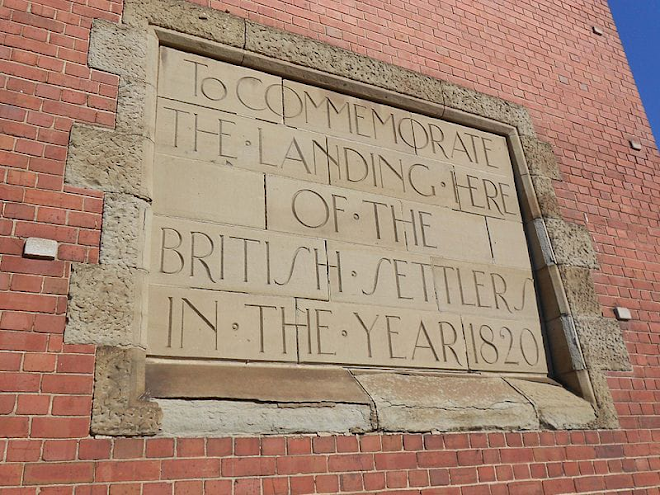
The next immigration scheme was the 1820 Settlers, which brought out
approx. 4500 settlers. They arrived on board 21 ships, the first being the
Chapman:, arrived in Algoa Bay on 09 April 1820. Among the settlers were
artisans, tradesmen, ministers of religion, merchants, teachers,
bookbinders, blacksmiths, discharged sailors and soldiers, professional men
and farmers. They were settled in British Kaffraria, where their first
homes were the tents given to them by the government. They pitched their
tents once they had chosen their piece of land. Their first task was to
build a more permanent abode for their families, after which they started
to till the lands. The government wanted them as farmers, but many settlers
did not have farming experience. Soon the drift towards towns started and
this is where these settlers started making their mark on South African
society. They started a free press, schools, churches, and businesses.
Those who had stayed on the farms eventually began to prosper.
Dr George Thom was the first of several Scotsmen to leave the London
Missionary Society for the Dutch Reformed Church at the Cape. He left
London in early 1822 with Rev. Andrew Murray and 6 teachers. They arrived
at the Cape on 02 July 1822 on board the Arethusa:.
Joseph Byrne organized some 4500 British settlers in 1849 to settle in
Natal, known as the Byrne Settlers. Groups of Cornish miners came to work
on the copper mines in Namaqualand from 1850. On 05 September 1850, the
Zenobia: arrived in Table Bay with approx. 230 new settlers who were mostly
artisans. Between 18571862, approx. 5800 immigrants arrived under the Cape
of Good Hope Immigration Board, which had an agent based in London. This
scheme offered free passage to suitable applicants. In 1860, discharged
British soldiers were offered land to come and settle at the Cape and many
took up this offer. A lot of British settlers worked on building the
railways after 1872. The discovery of diamonds and gold also brought more
British to South Africa. The Cape government started an immigration scheme
in 1873 by which settled residents could sponsor new settlers by
undertaking to give them employment.
Irish immigrants also made their home in South Africa. The first Irish were
soldiers sent out during the first and second British occupations. There
were 3 Irish Cape Governors: George, 1st Earl Macartney; Du Pre Alexander,
Earl of Caledon and Sir John Francis Cradock. Henry Nourse, a shipowner at
the Cape, brought out a small party of Irish settlers in 1818. In 1823,
John Ingram brought out 146 Irish from Cork. Single Irish women were sent
to the Cape on a few occasions. Twenty arrived in November 1849 and 46
arrived in March 1851. The majority arrived in November 1857 aboard the
Lady Kennaway:. A large contingent of Irish troops fought in the Anglo-Boer
War and a few of them stayed in South Africa after the war. Others returned
home but later came out to settle in South Africa with their families.
Between 1902 and 1905, there were approx. 5000 Irish immigrants.
The British contributed in many ways, founding the first university,
building roads, developing the harbours, developing the first banks,
creating the postal, telegraph and railway services. However, it has only
been in the last few years that more genealogical research has been done on
families originating from the UK. Although it is becoming easier to trace
their roots in South Africa, one does meet brick walls quite often,
especially when trying to trace back to the UK.
Sources:
British residents at the Cape 17951819, Peter Philip, 1981
They were South Africans, John Bond, 1958
In search of South Africa, H.V. Morton, 1948
Copyright 1998 Anne Lehmkuhl
----------------------------------------------


Saturday, June 14, 2014


Friday, June 13, 2014
A GIFT from my wife to me Algoa Bay Port Elizabeth
SHADOWS
Shadows cannot harm
us, though quite frightening they may seem,
They have no power or
substance; neither has a scary dream;
God’s Word so clearly
tells us that death’s valley we’ll walk through*
is also just a
shadow, and that He will be there too.
To fear is not an
option – fear’s a shadow and not real;
God’s power within us
has prevailed against the gates of hell;
So trust His many
promises, for faithful He will be,
Those evil, lurking
shadows will all simply have to flee.
And one day we will
see Him, in His glory, face to face,
Filled with awe and
wonder at the warmth of His embrace;
Earth’s sad and
painful memories will like shadows disappear
in the Sunshine of
His Presence, and He’ll be forever near
Reproduced by kind permission
Copyright SJA
Thursday, June 12, 2014

Tuesday, June 10, 2014
GOD's Laminin Algoa Bay Port Elizabeth
Here
is a pretty neat story and an interesting thing that
few of us know. It's
brief, so please read. (FROM A DOCTOR)
A couple of days ago I was running (I use that term very loosely) on my treadmill, watching a DVD sermon by Louie Giglio... And I was BLOWN AWAY! I want to share what I learned....
He (Louie) was talking about how inconceivably BIG our God is... How He spoke the universe into being.. How He breathes stars out of His mouth that are huge raging balls of fire.. Etc. Etc. Then He went on to speak of how this star-breathing, universe creating God ALSO knitted our human bodies together with amazing detail and wonder. At this point I am LOVING it (fascinating from a medical standpoint, you know.) .. And I was remembering how I was constantly amazed during medical school as I learned more and more about God's handiwork. I remember so many times thinking..'How can ANYONE deny that a Creator did all of this???'
Louie went on to talk about how we can trust that the God who created all this, also has the power to hold it all together when things seem to be falling apart...how our loving Creator is also our sustainer.
And then I lost my breath. And it wasn't because I was running my treadmill, either!!!
It was because he started talking about laminin. I knew about laminin.. Here is how Wikipedia describes them: 'Laminins are a family of proteins that are an integral part of the structural scaffolding of basement membranes in almost every animal tissue' You see.... Laminins are what hold us together... LITERALLY. They are cell adhesion molecules. They are what holds one cell of our bodies to the next cell. Without them, we would literally fall apart. And I knew all this already. But what I didn't know is what they LOOKED LIKE..
But now I do. And I have thought about it a thousand times since (already)....Here is what the structure of laminin looks like... AND THIS IS NOT a 'Christian portrayal' of it.... If you look up laminin in any scientific/medical piece of literature, this is what you will see....

A couple of days ago I was running (I use that term very loosely) on my treadmill, watching a DVD sermon by Louie Giglio... And I was BLOWN AWAY! I want to share what I learned....
He (Louie) was talking about how inconceivably BIG our God is... How He spoke the universe into being.. How He breathes stars out of His mouth that are huge raging balls of fire.. Etc. Etc. Then He went on to speak of how this star-breathing, universe creating God ALSO knitted our human bodies together with amazing detail and wonder. At this point I am LOVING it (fascinating from a medical standpoint, you know.) .. And I was remembering how I was constantly amazed during medical school as I learned more and more about God's handiwork. I remember so many times thinking..'How can ANYONE deny that a Creator did all of this???'
Louie went on to talk about how we can trust that the God who created all this, also has the power to hold it all together when things seem to be falling apart...how our loving Creator is also our sustainer.
And then I lost my breath. And it wasn't because I was running my treadmill, either!!!
It was because he started talking about laminin. I knew about laminin.. Here is how Wikipedia describes them: 'Laminins are a family of proteins that are an integral part of the structural scaffolding of basement membranes in almost every animal tissue' You see.... Laminins are what hold us together... LITERALLY. They are cell adhesion molecules. They are what holds one cell of our bodies to the next cell. Without them, we would literally fall apart. And I knew all this already. But what I didn't know is what they LOOKED LIKE..
But now I do. And I have thought about it a thousand times since (already)....Here is what the structure of laminin looks like... AND THIS IS NOT a 'Christian portrayal' of it.... If you look up laminin in any scientific/medical piece of literature, this is what you will see....
He is the image of the
invisible God, the firstborn over all creation. All things were created by
him and for him. He is before all things, and in him All things HOLD
TOGETHER.' Colossians 1:15-17
Call me crazy. I just think
that is very, very, very cool. Thousands of years before the world knew
anything about laminin, Paul penned those words. And now we see that from a very
LITERAL standpoint, we are held
together... One cell to another.... By the cross.
You would never in a quadrillion years convince me that is anything other than the mark of a Creator who knew EXACTLY what laminin 'glue' would look like long before Adam breathed his first breath!!
What I found when I googled laminin !!!!!!!!!!!
You would never in a quadrillion years convince me that is anything other than the mark of a Creator who knew EXACTLY what laminin 'glue' would look like long before Adam breathed his first breath!!
What I found when I googled laminin !!!!!!!!!!!

The cross is supposed to be
swinging when you receive this. I hope it still is. This is cool - had to pass
it on. I think we could all use a miracle. I know I certainly can!
Uploaded Email. Source
unknown
Monday, June 9, 2014
Sunday, June 8, 2014




Wednesday, June 4, 2014


Sunday, June 1, 2014




Subscribe to:
Posts (Atom)